The ESTS is happy to announce a new issue of Variants, the peer-reviewed journal of The European Society for Textual Scholarship, published in Open Access via the OpenEdition platform at https://journals.openedition.org/variants. The theme of this issue, edited by Wout Dillen, Elsa Pereira, and Stefano Rosignoli, is “Authors and their Drafts in Context”. Unlike previous themed issues in our series, this title does not repeat the theme of a specific past ESTS conference that set the issue in motion and determined its call for papers. Instead, we picked this title because different combinations of “authors”, “drafts”, and their “contexts” appear in each of the essays, and because the title combines elements of the themes of two conferences that are featured in the current issue: ESTS 2023 (Canterbury, UK) and GENESIS 2023 (Taipei, Taiwan). For more context regarding the composition and publication of this issue, please refer to the Editors’ Preface.
We hope that you enjoy the contributions carefully compiled here and look forward to the publication of Variants 20, which we are preparing for publication in 2026 as we speak.
ESTS
Call for Papers: ESTS 2026
The 21st annual conference of the European Society for Textual Scholarship
Venue: John Paul II Catholic University of Lublin, Lublin, Poland
Dates: 28-30 May 2026
Pre-Conference Workshop: 27 May 2026
Edition and Interpretation
Abstract submission deadline: 30 November 2025
The European Society for Textual Scholarship warmly invites scholars, researchers, and practitioners to participate in its 21st annual conference, bringing together international experts in textual scholarship and textual culture. At the heart of this conference lies the concept of interpretation — a fundamental practice that bridges textual scholarship and literary criticism, opening productive dialogues between editorial methodologies and critical approaches to understanding texts.
The central focus of ESTS 2026 is the complex relationship between editorial practice and textual interpretation. We seek to examine how editorial decisions fundamentally shape textual understanding, and conversely, how interpretative frameworks inform editorial methodology. We welcome submissions that engage with the full spectrum of textual scholarship, encompassing both traditional philological approaches and innovative digital methodologies. We particularly encourage submissions that explore how scholarly editions generate new interpretative possibilities, how manuscripts and printed books reveal layers of meaning through their materiality, and how textual scholarship provides fresh angles and evidence for literary criticism.
We invite contributions addressing, but not limited to, the following areas:
- Classical Textual Criticism: Theories and methodologies of scholarly editing, textual criticism, and philological practice, with attention to how editorial choices influence interpretative possibilities.
- Genetic Criticism and Authorial Philology: Analysis of creative processes, textual materiality, and the editorial treatment of authorial drafts and variants, exploring how manuscript evidence shapes our understanding of literary works.
- Material Texts and Interpretation: Studies of manuscripts, printed books, and other textual artifacts that demonstrate how physical features, layouts, marginalia, and paratexts contribute to meaning-making and interpretative practices.
- Interdisciplinary Approaches: Integration of literary studies, philosophy, linguistics, art history, and computational methods in textual research, with emphasis on interpretative frameworks.
- Comparative Textual Criticism: Exploration of editorial traditions and methodologies across diverse cultural and linguistic contexts, examining how different editorial approaches yield distinct interpretative outcomes.
- Digital Humanities in Textual Scholarship: TEI encoding, Handwritten Text Recognition (HTR) technologies, digital scholarly editions, visualisation of textual variants, and data interoperability standards, with attention to how digital tools open new interpretative dimensions.
- Case Studies: Critical editions of literary, philosophical, musical, or manuscript works that demonstrate the interplay between editorial practice and interpretation, with particular attention to how editorial challenges and solutions affect textual understanding and critical reception.
- Editorial Practice and Literary Criticism: Explorations of how scholarly editions inform, challenge, or transform literary interpretation, and how interpretative theories and practices influence editorial decisions.
Submission Guidelines
- Abstracts must be submitted in English (maximum 250 words + bio of maximum 100 words) through a submission platform on ests2026.arfi.kul.pl
- Presentations will be allocated 20 minutes, followed by 10 minutes for discussion.
- Contributors and panel chairs must pay the conference fee and must be members in good standing of the European Society for Textual Scholarship for 2026 (except invited speakers).
- Conference Fees: standard registration €100; reduced rate (postgraduate students and early-career researchers) €75.
Important Dates
- Abstract Submission Deadline: 30 November 2025
- Notification of Acceptance: 20 January 2026
- Conference Fee Payment Deadline: 31 March 2026
- Final Programme Publication: 1 April 2026
- Pre-Conference Workshop: 27 May 2026
- Conference: 28–30 May 2026
For more details, including how to submit, visit the conference website here.
STS representative to the ESTS Board
We are pleased to announce Stephanie Browner as the new representative of the Society for Textual Scholarship (STS) to the Board of the European Society for Textual Scholarship (ESTS).
We look forward to working with this esteemed colleague and contributing to ongoing scholarly discussions across the pond.
Call for papers for Variants
Participants of the 20th Annual Conference of the European Society for Textual Scholarship are warmly encouraged to submit a full-paper version of their talk to Variants, the Journal of the European Society for Textual Scholarship. As always, scholars who did not attend the ESTS 2025 conference are also welcome to contribute to our journal.
Variants is a diamond Open Access journal that publishes high-quality research in textual scholarship and is maintained by and for the ESTS community. The journal always welcomes spontaneous submissions, but also puts out targeted calls for papers after relevant conferences to invite presenters to develop their talks into full-length articles for publication. Submissions that fall within the scope of the journal will be considered for the next available issue and included in our external single-blind peer review process.
Papers submitted in response to this call will be considered for Variants 20, scheduled for publication in 2026. We expect to receive the full papers at the end of this summer. The suggested length of submissions for Variants is approximately 7000 words, excluding references and appendices, and should be written in English. For more details, please check out our page with Information for Authors.
If you are interested in submitting a paper for Variants, please send an Expression of Interest to <variants@textualscholarship.eu> by Friday 6 June. In your message, please include:
- The name(s) of the author(s);
- A preliminary title for the contribution;
- A preliminary abstract of approximately 200 words; and
- At least two suggestions for possible reviewers.
If you are basing your contribution on your conference paper, you are free to repurpose the title and abstract you submitted to the conference to the extent that it is still relevant.
For the reviewers, please include their name, affiliation, and work email address. The reviewers you suggest must be relevant to your field and unlikely to decline an invitation for purely conflict of interest reasons. Please be aware that these reviewers are suggestions and that the editors of the issue may or may not decide to contact one or more of your suggestions in the review process.
The preliminary timeline for the publication process for this issue looks as follows:
- 6 June 2025: Expression of Interest
- 1 September 2025: Full paper deadline
- December 2025: conclusion of reviewing process
- Spring 2026: revision and copyediting stages
- Fall 2026: Publication
If you have further questions, please do not hesitate to send a message to <variants@textualscholarship.eu>.
We very much look forward to receiving your Expression of Interest and reading your full submissions!
On behalf of the Editorial Board of Variants,
Wout Dillen (General Editor)
Elsa Pereira (Associate Editor)
Stefano Rosignoli (Review Editor)
ESTS 2025 Programme
For its twentieth annual conference, the European Society for Textual Scholarship is heading to Tours, the heart of the Loire Valley, from the 28th to the 30th of April 2025. The CESR – Centre d’Études Supérieures de la Renaissance at the University of Tours – welcomes the ESTS community to the birthplace of the French Renaissance to discuss Manuscripts in the Age of Print. The conference topic is inspired by the new ERC project PRIMA, which focuses on manuscript production, circulation, and consumption in Ancient Regime Europe.
The programme organised by the conference team includes various social activities, a workshop, a poster session, plenary lectures, and almost 50 oral presentations. It will also host the Board Meeting that welcomes the newly elected Board Members and Officers of the ESTS.
For more details, please visit the conference website here.
2025 Membership and Board Elections
The ESTS Board has received nominations from three strong candidates whose eligibility has been confirmed. Since the number of eligible candidates did not exceed the number of vacancies, we do not need to organise further elections. Instead, we are pleased to announce Beatrice Nava, Krista Stinne Greve Rasmussen, and Paulius V. Subačius as Board members and look forward to welcoming them to our next annual meeting.
In 2025, the ESTS conference is heading to Tours (France) from the 28th to the 30th of April. Registration will officially open by the end of January, but please note that all registered speakers must be paid-up members of the Society. The ESTS annual membership begins on the 1st of January (ending on the 31st of December). Please do not forget to renew your membership by transferring the 2025 fee to the Society’s bank account. For further information, please refer to the webpage https://textualscholarship.eu/membership/.
Variants 17-18 is out!
The ESTS is happy to announce a new issue of Variants, the peer-reviewed journal of The European Society for Textual Scholarship, published in Open Access via the OpenEdition platform at https://journals.openedition.org/variants. This double issue was edited by Wout Dillen, Elli Bleeker, and Stefano Rosignoli.
Variants 17–18 contains essays from the consecutive GENESIS and ESTS 2022 conferences as well as essays and reviews that have been submitted outside this context but fit beautifully within the joint themes of creative revision (GENESIS) and the history and study of ancient and modern holographs (ESTS). For more context regarding the composition and publication of this issue, please refer to the Editors’ Preface.
We hope that you enjoy the research presented in this volume. If you do, you may be happy to learn that the work on our next volume is already well underway. We have a number of essays accepted and under review that are expanded full-paper versions of research presented at last year’s GENESIS conference in Taipei, the ESTS conference in Canterbury, as well as some conference independent submissions. As such, Variants 19, which is scheduled for publication in 2025, is already shaping up to be another sizeable volume of relevant research that, like our current issue, we hope will provide plenty food for thought and help inspire spirited discussions in the field.
ESTS 2024 Conference Announcement and CfP
The nineteenth annual conference of the European Society for Textual Scholarship will take place this year at Eötvös Loránd University, Budapest, 2-4 October 2024. The Call for Papers can be read below.
CALL FOR PAPERS
Textual scholarship, artificial intelligence, corpora and intelligent editions
The nineteenth annual conference of the European Society for Textual Scholarship (ESTS 2024)
Eötvös Loránd University, Budapest 2-4 October 2024
CfP deadline 1 June 2024
Although the deep learning-based AI revolution in human language processing began at least a decade ago, the emergence of generative AI through ChatGPT has far exceeded even experts’ expectations. Will AI make textual scholarship and our editing practices smarter? Will we be able to produce intelligent editions, in print or online, without the “help” of computers in the third decade of the 21st century?
In this context, it is worth considering the opportunities and threats of the computer as a cultural artefact in the production of scholarly editions, or in textual scholarship in general, from the Index Thomisticus (Roberto Busa) to Winchester Philology (Thorsten Ries) and the technology of the Semantic Web. The conference also addresses the role of corpora and corpus linguistic methods in the humanities, such as computer-based analysis and annotation of poetic texts.
Papers on the following or related topics are welcome:
- What is an Intelligent Edition?
- Who is the (digital) edition for?
- Can editions become more inclusive?
- What challenges is textual scholarship facing?
- Is there a future for print?
- Textual Scholarship and/as data
- Editorial Interfacing
- (Digital) Research Infrastructure and Future-proofing the Edition
- Editing and Deep Learning
- Corpus linguistics as Method and Tool
- Annotation and Commentary in the Age of Google
Topics of interest include, but are not limited to the following:
- Scholarly editing, textual scholarship and/as research data – in the age of FAIR data management.
- Versioning, persistent identification, standardization, metadata schemes, data mining, search tools, search platforms. Named entity recognition, data enrichment, linked open data.
- Scholarly editions on display. Displaying scholarly editions.
- Arrangement of philological data on the printed surface of paper and on the computer displays, marking-up, sign systems in print and on the screen, relation of the visual arrangement of the source and the edition; lists, glossaries, annotations, marginalia and footnotes: what they disclose and what they hide. Digital interfaces, responsive design and visual stability/instability. Digitizing scholarly editions and printing digital ones.
- Rule based digital tools, automatic collation, data visualization; intertextuality detection, stylometry and authorship attribution: old and new methods. Deep learning (HTR, LLM), digital research infrastructures.
- Corpus linguistic methods and tools in poetic research: canonical and non-canonical poetic genres, characteristics of lyrical and narrative poetry (e.g. grammatical and semantic patterns, poetic styles and devices, literary periods), quantitative and qualitative methods.
- Electronic literature and the challenges of textual scholarship.
- Born-digital and digitized sources and the challenges of textual scholarship.
- The audiences of digital and printed editions.
Contributions to the ESTS Conference may take the following forms:
- Research Papers
Individual scholars are welcome to submit proposals for papers which may then be selected for
panels. 20 minutes in length. Please supply an abstract of 150 words (max) + bio of 100 words
(max). - Panel sessions
We also invite groups of scholars (3 speakers) to submit proposals for thematically linked research paper panels. 90 minutes in length (3 x 20 minute papers + q&a). Please supply 3 abstracts of 150 words (max) each + bios of 100 words (max) for each speaker. The organisers will give preference to panels that reflect the diversity of our field. - Roundtable
We also invite groups of scholars (up to 6 speakers) to submit proposals for thematically linked roundtable sessions. 90 minutes in length (10 mins per speaker + q&a). Please supply an overall abstract of 250 words (250 words) for the roundtable + bios of 100 words (max) for each speaker. - Poster sessions
We will run a poster session as part of the main conference program. Topics of interest include all topics listed above. The poster session is an opportunity for researchers to discuss their early/ongoing work with attendees. The posters presented are to be between sizes A3 and A2; Please provide an abstract of maximum 250 words.
Proposals are to be submitted on the registration link by 15 May 2024.
Proposals are to be reviewed by early June.
Further information
Should you have any questions, feel free to reach out to us at the email address below:
dh-conference@btk.elte.hu
Organisers
The Organising Committee
ESTS – The European Society for Textual Scholarship
ELTE-DH – Department of Digital Humanities, Eötvös Loránd University
ELTE-MIKTI – Institute of Hungarian Literature and Cultural Studies, Eötvös Loránd University
ELTE-DiAGram – Research Group in Stylistics
ESTS Conference 2023 – Proposal Deadline Extension
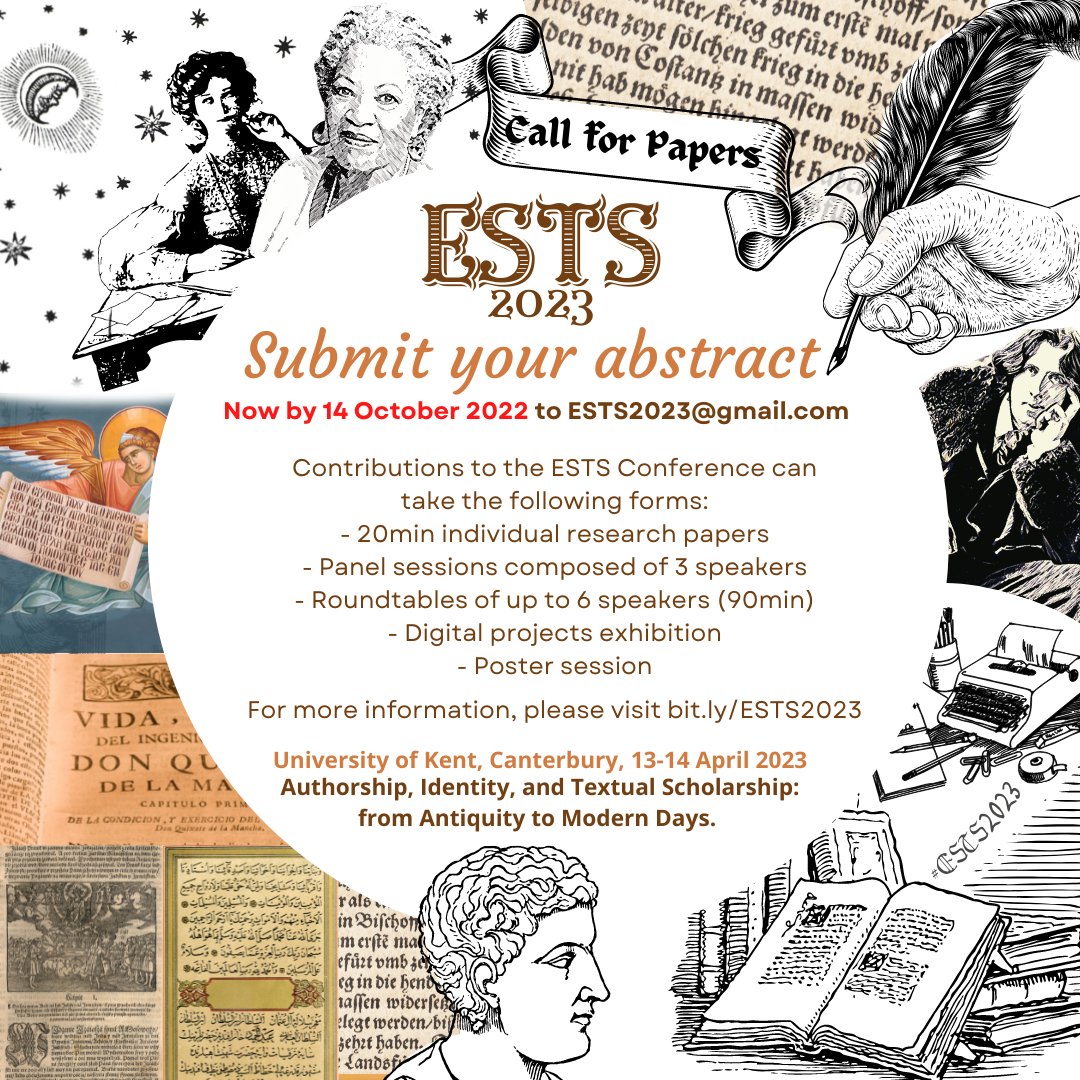
The 18th annual ESTS conference will be taking place at the University of Kent from 13-14 April 2023, and the deadline for proposals has now been extended to Friday 14th October 2022. To read the call for papers, please visit the ESTS 2023 Conference Website, where you’ll also be able to find information on registration, contributions, and where to send abstracts.
Follow the ESTS 2023 Twitter, or join the ESTS Facebook Group for up-to-date announcements and information about the conference.


Variants 15: Call for Submissions
Dear Colleagues,
As the editors of Variants, the Journal of the European Society for Textual Scholarship, we would like to invite you to submit an essay for the fifteenth edition of our journal. Variants is an Open Access journal, published by OpenEdition publishers. The journal will carry the title of our most recent ESTS conference in Málaga: “Textual Scholarship in the 21st Century”, and we especially welcome extended versions of papers that were presented at the conference. But essays outside of the conference are welcome too, on any aspect of textual scholarship such as the theories and practices of (digital) scholarly editing, tool development, genetic criticism, codicology and palaeography, philology, manuscript studies, etc.
Full papers are due by Friday March 13, 2020. If you are interested in submitting an essay, please send an expression of interest by Friday January 10th, that includes a brief description of the essay’s topic (approximately 50 to 100 words) to variants@textualscholarship.eu. If you’re interested in submitting a review, please send an email to rosignoli.stefano@gmail.com by December 31st, motivating the publication of a review on a given edition or monograph on textual scholarship.
For authors who are comfortable writing in LaTeX, we have prepared a template that is available on GitHub (https://github.com/WoutDLN/variantx-for-authors) and as an Overleaf template (https://www.overleaf.com/latex/templates/submission-template-to-variants-for-authors/znsqffgrvshv). But we accept submissions, in .docx and its open source equivalents as well.
If you have any further questions, please do not hesitate to forward them to us!
We look forward to receiving your submissions,
The Editorial board of Variants,