Call for Papers: STS 2026

Venue: The New School, New York City

Dates:  3-5 June 2026

Materiality, Memory, Forgetting: Cross-currents in Textual Studies and Memory Studies

Abstract submission deadline: 1 February 2026

The Society for Textual Scholarship (North America) warmly invites scholars to participate in its annual conference to explore the rich and evolving relationship between Textual Studies and Memory Studies.

Proposals are welcome to engage with a wide range of topics, including (but not limited to):

  • Texts (broadly conceived) as Sites or Agents of Memory and Forgetting
  • Editorial Practice and the Politics of Remembrance
  • Manuscripts and Memory work 
  • Scribal Memory / Print Memory / Digital Memory
  • Text, Palimpsest, Memory
  • Textual Ruins, Fragmentary Memory 
  • Text as Monument / Monuments as Text
  • Archival Memory / Archival Forgetting
  • Archives and the Future of Memory
  • Memory, Materiality, and Textual Transmission
  • Textual scholarship in Transitional Justice and Historical Reckoning
  • Memory, Censorship, and the Re-writing of History
  • Canon, Memory, Forgetting: What/whose texts are remembered, whose are forgotten?
  • AI and Memory / AI’s Memory
  • Editing and Re-memory / Editing and Post-memory
  • Artifacts as Memory Sites
  • Postcolonial and Decolonial Approaches to Memory
  • Diaspora and the Textual Transmission of Memory
  • Textual Memory and Decolonization
  • Queer Memory
  • Testimony, Trauma, and Textual Forms
  • Aging Bodies / Texts of Memory
  • Memory and the Textual Poetics of Care
  • Memory in Marginalia, Annotations, and Paratexts

In a joint effort to strengthen the bonds between the Society for Textual Scholarship (STS) and The European Society for Textual Scholarship (ESTS), we invite our members to participate in the 2026 STS conference in New York. Proposed session formats may include workshops/seminars, panels, roundtables, and individual papers. As such, ESTS members planning to attend the conference are welcome to submit an individual paper proposal, informing the STS organisation that it should be included in the ESTS panel. Alternatively, a joint panel proposal of 3-4 ESTS members may also be submitted on behalf of the ESTS membership.

Abstracts should be submitted by 1 February 2026 to societyfortextualscholarship@gmail.com

Please do not hesitate to contact the ESTS Secretary if you need assistance to coordinate this delegation.

For more details, including how to submit, visit the conference website here.

ESTS 2026 CFP Deadline Extension

If you were planning to submit an abstract for our upcoming ESTS 2026 conference (28–30 May 2026 in Lublin, Poland), but ran out of time, we have good news: the deadline has just been extended until 20 December 2025!

This year’s theme is Edition and Interpretation, but, as usual, abstracts engaging with the full spectrum of textual studies and (digital) scholarly editing are also welcome.

Please visit the conference’s official website for more information.

We look forward to reading your submissions and hope to see you in Lublin!

Reminder: CfP ESTS 2026

Here is a gentle reminder that the submission deadline for our ESTS 2026 conference (28-30 May in Lublin, Poland) is 30 November!
This year’s theme is Edition and Interpretation, but, as usual, abstracts engaging with the full spectrum of textual studies and (digital) scholarly editing are also welcome.

Please visit the conference’s official website for more information.

We look forward to reading your submissions and hope to see you in Lublin!

Call for Papers: ESTS 2026

The 21st annual conference of the European Society for Textual Scholarship

Venue: John Paul II Catholic University of Lublin, Lublin, Poland

Dates:  28-30 May 2026

Pre-Conference Workshop: 27 May 2026

Edition and Interpretation

Abstract submission deadline: 30 November 2025

The European Society for Textual Scholarship warmly invites scholars, researchers, and practitioners to participate in its 21st annual conference, bringing together international experts in textual scholarship and textual culture. At the heart of this conference lies the concept of interpretation — a fundamental practice that bridges textual scholarship and literary criticism, opening productive dialogues between editorial methodologies and critical approaches to understanding texts.

The central focus of ESTS 2026 is the complex relationship between editorial practice and textual interpretation. We seek to examine how editorial decisions fundamentally shape textual understanding, and conversely, how interpretative frameworks inform editorial methodology. We welcome submissions that engage with the full spectrum of textual scholarship, encompassing both traditional philological approaches and innovative digital methodologies. We particularly encourage submissions that explore how scholarly editions generate new interpretative possibilities, how manuscripts and printed books reveal layers of meaning through their materiality, and how textual scholarship provides fresh angles and evidence for literary criticism.

We invite contributions addressing, but not limited to, the following areas:

  • Classical Textual Criticism: Theories and methodologies of scholarly editing, textual criticism, and philological practice, with attention to how editorial choices influence interpretative possibilities.
  • Genetic Criticism and Authorial Philology: Analysis of creative processes, textual materiality, and the editorial treatment of authorial drafts and variants, exploring how manuscript evidence shapes our understanding of literary works.
  • Material Texts and Interpretation: Studies of manuscripts, printed books, and other textual artifacts that demonstrate how physical features, layouts, marginalia, and paratexts contribute to meaning-making and interpretative practices. 
  • Interdisciplinary Approaches: Integration of literary studies, philosophy, linguistics, art history, and computational methods in textual research, with emphasis on interpretative frameworks.
  • Comparative Textual Criticism: Exploration of editorial traditions and methodologies across diverse cultural and linguistic contexts, examining how different editorial approaches yield distinct interpretative outcomes.
  • Digital Humanities in Textual Scholarship: TEI encoding, Handwritten Text Recognition (HTR) technologies, digital scholarly editions, visualisation of textual variants, and data interoperability standards, with attention to how digital tools open new interpretative dimensions. 
  • Case Studies: Critical editions of literary, philosophical, musical, or manuscript works that demonstrate the interplay between editorial practice and interpretation, with particular attention to how editorial challenges and solutions affect textual understanding and critical reception.
  • Editorial Practice and Literary Criticism: Explorations of how scholarly editions inform, challenge, or transform literary interpretation, and how interpretative theories and practices influence editorial decisions.

Submission Guidelines

  • Abstracts must be submitted in English (maximum 250 words + bio of maximum 100 words) through a submission platform on ests2026.arfi.kul.pl
  • Presentations will be allocated 20 minutes, followed by 10 minutes for discussion.
  • Contributors and panel chairs must pay the conference fee and must be members in good standing of the European Society for Textual Scholarship for 2026 (except invited speakers).
  • Conference Fees: standard registration €100; reduced rate (postgraduate students and early-career researchers) €75.

Important Dates

  • Abstract Submission Deadline: 30 November 2025
  • Notification of Acceptance: 20 January 2026
  • Conference Fee Payment Deadline: 31 March 2026
  • Final Programme Publication: 1 April 2026
  • Pre-Conference Workshop: 27 May 2026
  • Conference: 28–30 May 2026

For more details, including how to submit, visit the conference website here.
ESTS 2025 Programme

For its twentieth annual conference, the European Society for Textual Scholarship is heading to Tours, the heart of the Loire Valley, from the 28th to the 30th of April 2025. The CESR – Centre d’Études Supérieures de la Renaissance at the University of Tours – welcomes the ESTS community to the birthplace of the French Renaissance to discuss Manuscripts in the Age of Print. The conference topic is inspired by the new ERC project PRIMA, which focuses on manuscript production, circulation, and consumption in Ancient Regime Europe.

The programme organised by the conference team includes various social activities, a workshop, a poster session, plenary lectures, and almost 50 oral presentations. It will also host the Board Meeting that welcomes the newly elected Board Members and Officers of the ESTS.

For more details, please visit the conference website here.

ESTS Conference 2023 – Proposal Deadline Extension

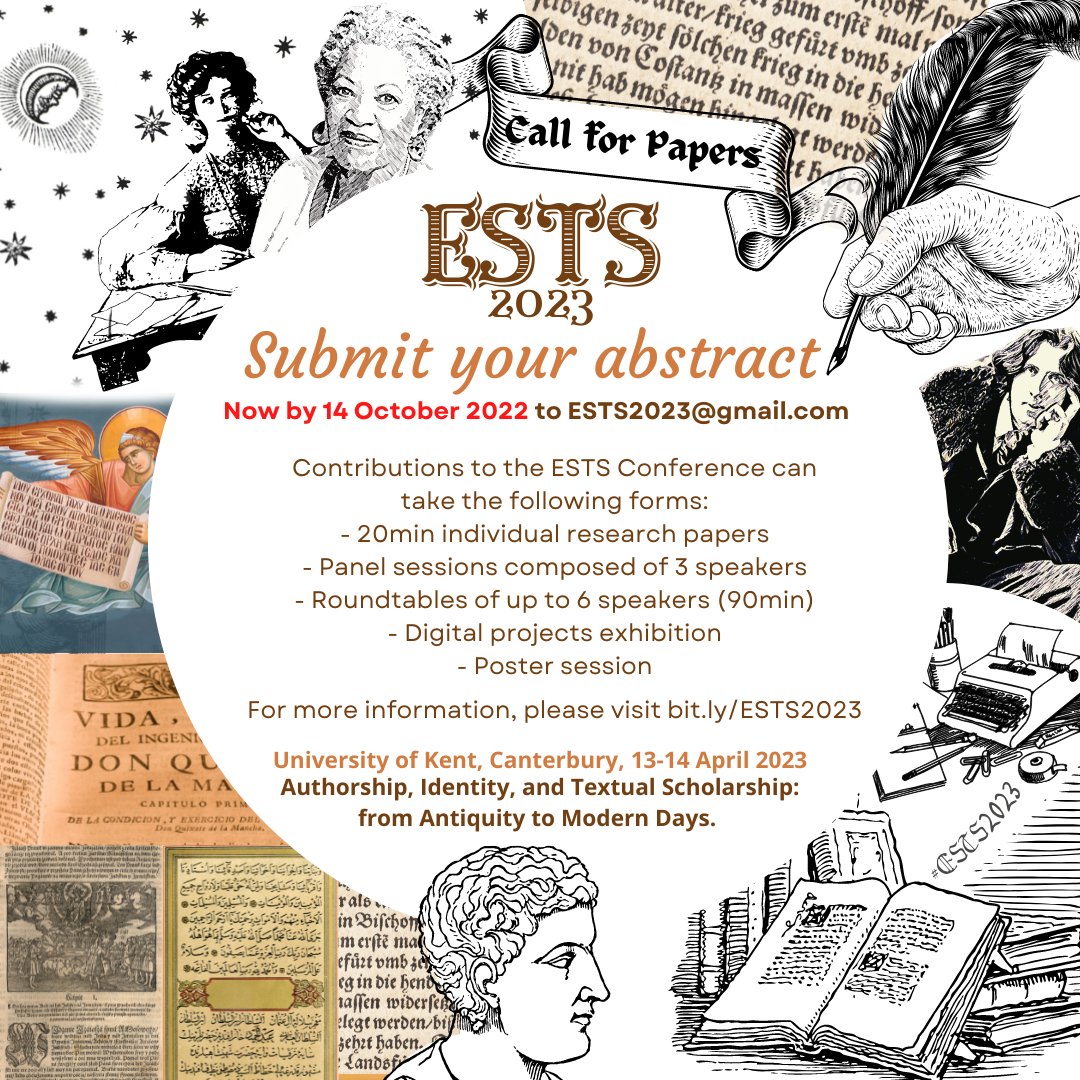
The 18th annual ESTS conference will be taking place at the University of Kent from 13-14 April 2023, and the deadline for proposals has now been extended to Friday 14th October 2022. To read the call for papers, please visit the ESTS 2023 Conference Website, where you’ll also be able to find information on registration, contributions, and where to send abstracts.

Follow the ESTS 2023 Twitter, or join the ESTS Facebook Group for up-to-date announcements and information about the conference.