ESTS 2026 CFP Deadline Extension

If you were planning to submit an abstract for our upcoming ESTS 2026 conference (28–30 May 2026 in Lublin, Poland), but ran out of time, we have good news: the deadline has just been extended until 20 December 2025!

This year’s theme is Edition and Interpretation, but, as usual, abstracts engaging with the full spectrum of textual studies and (digital) scholarly editing are also welcome.

Please visit the conference’s official website for more information.

We look forward to reading your submissions and hope to see you in Lublin!

Reminder: CfP ESTS 2026

Here is a gentle reminder that the submission deadline for our ESTS 2026 conference (28-30 May in Lublin, Poland) is 30 November!
This year’s theme is Edition and Interpretation, but, as usual, abstracts engaging with the full spectrum of textual studies and (digital) scholarly editing are also welcome.

Please visit the conference’s official website for more information.

We look forward to reading your submissions and hope to see you in Lublin!

Call for Papers: ESTS 2026

The 21st annual conference of the European Society for Textual Scholarship

Venue: John Paul II Catholic University of Lublin, Lublin, Poland

Dates:  28-30 May 2026

Pre-Conference Workshop: 27 May 2026

Edition and Interpretation

Abstract submission deadline: 30 November 2025

The European Society for Textual Scholarship warmly invites scholars, researchers, and practitioners to participate in its 21st annual conference, bringing together international experts in textual scholarship and textual culture. At the heart of this conference lies the concept of interpretation — a fundamental practice that bridges textual scholarship and literary criticism, opening productive dialogues between editorial methodologies and critical approaches to understanding texts.

The central focus of ESTS 2026 is the complex relationship between editorial practice and textual interpretation. We seek to examine how editorial decisions fundamentally shape textual understanding, and conversely, how interpretative frameworks inform editorial methodology. We welcome submissions that engage with the full spectrum of textual scholarship, encompassing both traditional philological approaches and innovative digital methodologies. We particularly encourage submissions that explore how scholarly editions generate new interpretative possibilities, how manuscripts and printed books reveal layers of meaning through their materiality, and how textual scholarship provides fresh angles and evidence for literary criticism.

We invite contributions addressing, but not limited to, the following areas:

  • Classical Textual Criticism: Theories and methodologies of scholarly editing, textual criticism, and philological practice, with attention to how editorial choices influence interpretative possibilities.
  • Genetic Criticism and Authorial Philology: Analysis of creative processes, textual materiality, and the editorial treatment of authorial drafts and variants, exploring how manuscript evidence shapes our understanding of literary works.
  • Material Texts and Interpretation: Studies of manuscripts, printed books, and other textual artifacts that demonstrate how physical features, layouts, marginalia, and paratexts contribute to meaning-making and interpretative practices. 
  • Interdisciplinary Approaches: Integration of literary studies, philosophy, linguistics, art history, and computational methods in textual research, with emphasis on interpretative frameworks.
  • Comparative Textual Criticism: Exploration of editorial traditions and methodologies across diverse cultural and linguistic contexts, examining how different editorial approaches yield distinct interpretative outcomes.
  • Digital Humanities in Textual Scholarship: TEI encoding, Handwritten Text Recognition (HTR) technologies, digital scholarly editions, visualisation of textual variants, and data interoperability standards, with attention to how digital tools open new interpretative dimensions. 
  • Case Studies: Critical editions of literary, philosophical, musical, or manuscript works that demonstrate the interplay between editorial practice and interpretation, with particular attention to how editorial challenges and solutions affect textual understanding and critical reception.
  • Editorial Practice and Literary Criticism: Explorations of how scholarly editions inform, challenge, or transform literary interpretation, and how interpretative theories and practices influence editorial decisions.

Submission Guidelines

  • Abstracts must be submitted in English (maximum 250 words + bio of maximum 100 words) through a submission platform on ests2026.arfi.kul.pl
  • Presentations will be allocated 20 minutes, followed by 10 minutes for discussion.
  • Contributors and panel chairs must pay the conference fee and must be members in good standing of the European Society for Textual Scholarship for 2026 (except invited speakers).
  • Conference Fees: standard registration €100; reduced rate (postgraduate students and early-career researchers) €75.

Important Dates

  • Abstract Submission Deadline: 30 November 2025
  • Notification of Acceptance: 20 January 2026
  • Conference Fee Payment Deadline: 31 March 2026
  • Final Programme Publication: 1 April 2026
  • Pre-Conference Workshop: 27 May 2026
  • Conference: 28–30 May 2026

For more details, including how to submit, visit the conference website here.

Amendment to the bylaws

The Bylaws of the European Society for Textual Scholarship, containing the rules and regulations within which the Society operates, have been amended during our 20th annual conference, which took place in Tours, on 28-30 April 2025.

The current revised version of the Bylaws was approved by the ESTS Board on 28 April 2025 and ratified by the ESTS Membership during the 2025 General Members’ Meeting.

For more information, please refer to our Bylaws page.

ESTS Conference 2023 – Proposal Deadline Extension

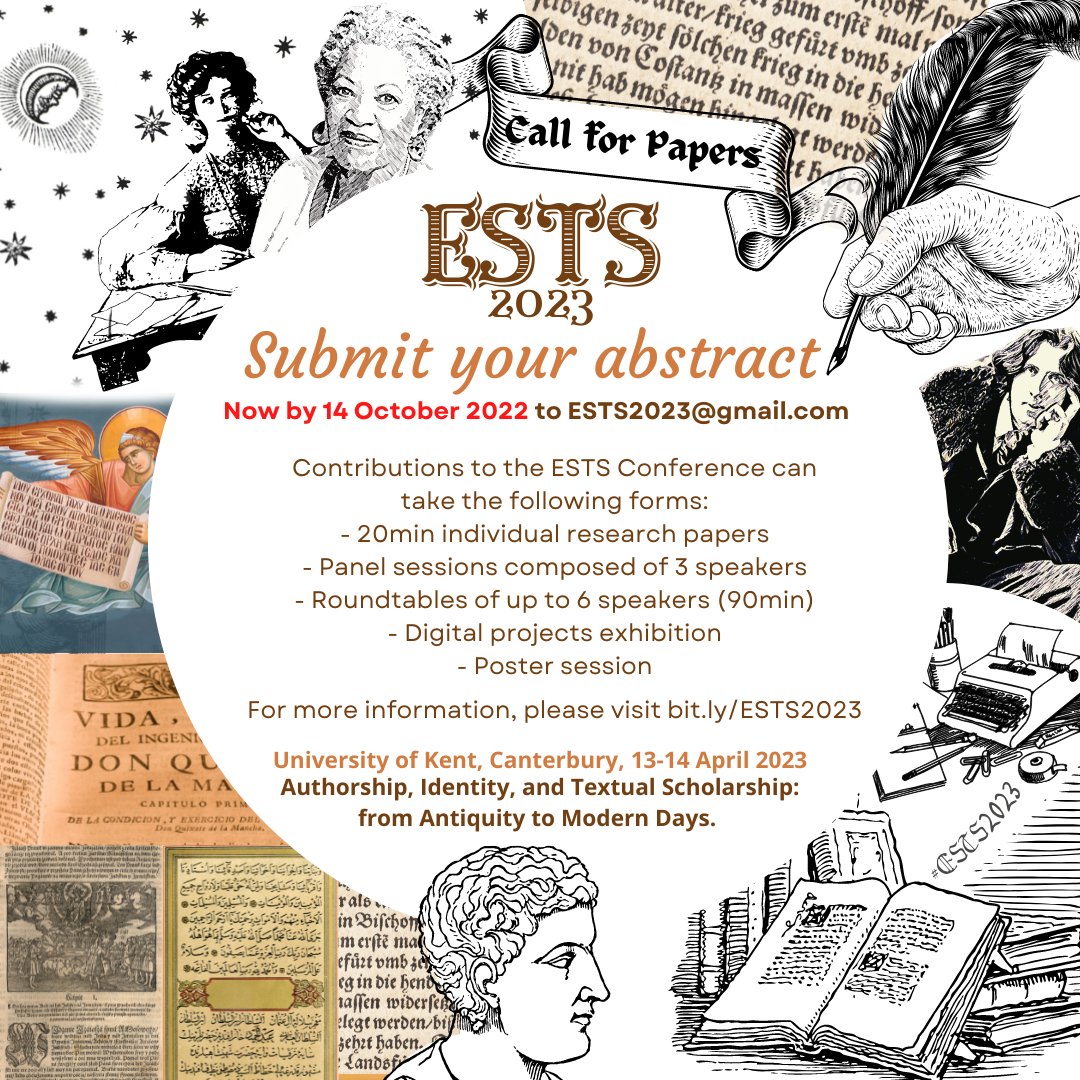
The 18th annual ESTS conference will be taking place at the University of Kent from 13-14 April 2023, and the deadline for proposals has now been extended to Friday 14th October 2022. To read the call for papers, please visit the ESTS 2023 Conference Website, where you’ll also be able to find information on registration, contributions, and where to send abstracts.

Follow the ESTS 2023 Twitter, or join the ESTS Facebook Group for up-to-date announcements and information about the conference.

Variants 15: Call for Submissions

Dear Colleagues,

As the editors of Variants, the Journal of the European Society for Textual Scholarship, we would like to invite you to submit an essay for the fifteenth edition of our journal. Variants is an Open Access journal, published by OpenEdition publishers. The journal will carry the title of our most recent ESTS conference in Málaga: “Textual Scholarship in the 21st Century”, and we especially welcome extended versions of papers that were presented at the conference. But essays outside of the conference are welcome too, on any aspect of textual scholarship such as the theories and practices of (digital) scholarly editing, tool development, genetic criticism, codicology and palaeography, philology, manuscript studies, etc.

Full papers are due by Friday March 13, 2020. If you are interested in submitting an essay, please send an expression of interest by Friday January 10th, that includes a brief description of the essay’s topic (approximately 50 to 100 words) to variants@textualscholarship.eu. If you’re interested in submitting a review, please send an email to rosignoli.stefano@gmail.com by December 31st, motivating the publication of a review on a given edition or monograph on textual scholarship.

For authors who are comfortable writing in LaTeX, we have prepared a template that is available on GitHub (https://github.com/WoutDLN/variantx-for-authors) and as an Overleaf template (https://www.overleaf.com/latex/templates/submission-template-to-variants-for-authors/znsqffgrvshv). But we accept submissions, in .docx and its open source equivalents as well.

If you have any further questions, please do not hesitate to forward them to us!

We look forward to receiving your submissions,

The Editorial board of Variants,

General Editor, Wout Dillen
Associate Editor, Elli Bleeker
Guest Editor, Laura Esteban Segura
Review Editor, Stefano Rosignoli

Variants 14

As was already announced on the Society’s Twitter and Facebook pages, we are happy to present the research community with a new issue of Variants, the annual, peer-reviewed journal of The European Society for Textual Scholarship!

Variants 14 is the second issue in the series that is published in Open Access via the OpenEdition platform (previously revues.org) at https://journals.openedition.org/variants. The issues was edited by Wim Van Mierlo, Wout Dillen, and Elli Bleeker – with Stefano Rosignoli functioning as the issue’s Review Editor.

With the publication of this issue, Wim has now officially resigned from his position as the General Editor of Variants, passing his duties on to Wout (as General Editor) and Elli (as Associate Editor). The new editors wish to thank Wim for his long and much appreciated service on the issue’s editorial board, and for his efforts (together with Aurélien Berra) to make the journal more accessible to the general public by moving it to an Open Access publication venue.

We look forward to presenting the issue at the 2019 edition of our annual conference (28-29 November 2017) – where we will also invite our Members (and other textual scholars and scholarly editors) to submit a paper for Variants 15. We hope to see you there!

CFP ESTS 2019

As announced at the Member’s Meeting at ESTS 2018 in Prague, the Society’s 16th annual conference will be held in Málaga, Spain and take place from 28 to 29 November 2019. This year’s theme will be ‘Textual Scholarship in the 21st Century’, and its Call for Proposals has just been put online, with the deadline for submissions set on 31 May 2018. For more information on this CFP, please refer to the conference page.

Please distribute widely. We look forward to receiving your abstracts, and welcoming you in Málaga!

ESTS Bylaws: New Proposal

Dear Members and old Members of the European Society for Textual Scholarship,

As was communicated at previous board meetings, our Board has been working on a redrafting of our Society’s bylaws. The new proposal is now approved by the Board, and ready to be communicated to the Membership – you will find it attached. As stated in our (previous and newly proposed) bylaws, Members in good standing (i.e. who have paid their Membership dues for 2017/Alcalá or later) reserve the right to vote on changes in the bylaws. That is why we now forward our proposal to see you have any objections to our proposal.

Those who are eligible are invited to respond to the proposed bylaws by forwarding their objections to the Society’s secretary (wout.dillen@uantwerpen.be) within the next two months (i.e. until 18 December 2018). Minor changes that are suggested by the Membership will be discussed by the Board, who will decide whether to adopt or reject the change. Major changes will be added to the draft and returned for consideration by the Membership. In this process, the Board reserves the right to decide what constitutes a ‘minor’ or ‘major’ change. After the period of two months has passed, the Bylaws will be considered as approved by the Membership, unless the Board decides to extend the initial period with a further month.

Although we will accept objections to the bylaws until 18 December, we would strongly encourage Members to respond to this document before this year’s Annual Members’ Meeting takes place (on Saturday 17 November 2018), where the board will reserve a slot for discussing any major changes that may have already come up, directly with the Membership.

We thank you for your input, and look forward to discussing the newly proposed bylaws with you in Prague!

All the best, on behalf of the ESTS board,

Anne Baillot
Isabel de la Cruz Cabanillas
Wout Dillen (secretary)
Jan Gielkens (treasurer)
Sakari Katajamäki
Roland S. Kamzelak</br/>
Anthony Lappin
Elena Pierazzo
Wim Van Mierlo (president)

Link to the proposal: https://textualscholarship.eu/wp-content/uploads/2018/10/bylaws-of-the-european-society-for-textual-scholarship.pdf