Call for Papers: STS 2026

Venue: The New School, New York City

Dates:  3-5 June 2026

Materiality, Memory, Forgetting: Cross-currents in Textual Studies and Memory Studies

Abstract submission deadline: 1 February 2026

The Society for Textual Scholarship (North America) warmly invites scholars to participate in its annual conference to explore the rich and evolving relationship between Textual Studies and Memory Studies.

Proposals are welcome to engage with a wide range of topics, including (but not limited to):

  • Texts (broadly conceived) as Sites or Agents of Memory and Forgetting
  • Editorial Practice and the Politics of Remembrance
  • Manuscripts and Memory work 
  • Scribal Memory / Print Memory / Digital Memory
  • Text, Palimpsest, Memory
  • Textual Ruins, Fragmentary Memory 
  • Text as Monument / Monuments as Text
  • Archival Memory / Archival Forgetting
  • Archives and the Future of Memory
  • Memory, Materiality, and Textual Transmission
  • Textual scholarship in Transitional Justice and Historical Reckoning
  • Memory, Censorship, and the Re-writing of History
  • Canon, Memory, Forgetting: What/whose texts are remembered, whose are forgotten?
  • AI and Memory / AI’s Memory
  • Editing and Re-memory / Editing and Post-memory
  • Artifacts as Memory Sites
  • Postcolonial and Decolonial Approaches to Memory
  • Diaspora and the Textual Transmission of Memory
  • Textual Memory and Decolonization
  • Queer Memory
  • Testimony, Trauma, and Textual Forms
  • Aging Bodies / Texts of Memory
  • Memory and the Textual Poetics of Care
  • Memory in Marginalia, Annotations, and Paratexts

In a joint effort to strengthen the bonds between the Society for Textual Scholarship (STS) and The European Society for Textual Scholarship (ESTS), we invite our members to participate in the 2026 STS conference in New York. Proposed session formats may include workshops/seminars, panels, roundtables, and individual papers. As such, ESTS members planning to attend the conference are welcome to submit an individual paper proposal, informing the STS organisation that it should be included in the ESTS panel. Alternatively, a joint panel proposal of 3-4 ESTS members may also be submitted on behalf of the ESTS membership.

Abstracts should be submitted by 1 February 2026 to societyfortextualscholarship@gmail.com

Please do not hesitate to contact the ESTS Secretary if you need assistance to coordinate this delegation.

For more details, including how to submit, visit the conference website here.

ESTS 2026 CFP Deadline Extension

If you were planning to submit an abstract for our upcoming ESTS 2026 conference (28–30 May 2026 in Lublin, Poland), but ran out of time, we have good news: the deadline has just been extended until 20 December 2025!

This year’s theme is Edition and Interpretation, but, as usual, abstracts engaging with the full spectrum of textual studies and (digital) scholarly editing are also welcome.

Please visit the conference’s official website for more information.

We look forward to reading your submissions and hope to see you in Lublin!

Reminder: CfP ESTS 2026

Here is a gentle reminder that the submission deadline for our ESTS 2026 conference (28-30 May in Lublin, Poland) is 30 November!
This year’s theme is Edition and Interpretation, but, as usual, abstracts engaging with the full spectrum of textual studies and (digital) scholarly editing are also welcome.

Please visit the conference’s official website for more information.

We look forward to reading your submissions and hope to see you in Lublin!

Call for Papers: ESTS 2026

The 21st annual conference of the European Society for Textual Scholarship

Venue: John Paul II Catholic University of Lublin, Lublin, Poland

Dates:  28-30 May 2026

Pre-Conference Workshop: 27 May 2026

Edition and Interpretation

Abstract submission deadline: 30 November 2025

The European Society for Textual Scholarship warmly invites scholars, researchers, and practitioners to participate in its 21st annual conference, bringing together international experts in textual scholarship and textual culture. At the heart of this conference lies the concept of interpretation — a fundamental practice that bridges textual scholarship and literary criticism, opening productive dialogues between editorial methodologies and critical approaches to understanding texts.

The central focus of ESTS 2026 is the complex relationship between editorial practice and textual interpretation. We seek to examine how editorial decisions fundamentally shape textual understanding, and conversely, how interpretative frameworks inform editorial methodology. We welcome submissions that engage with the full spectrum of textual scholarship, encompassing both traditional philological approaches and innovative digital methodologies. We particularly encourage submissions that explore how scholarly editions generate new interpretative possibilities, how manuscripts and printed books reveal layers of meaning through their materiality, and how textual scholarship provides fresh angles and evidence for literary criticism.

We invite contributions addressing, but not limited to, the following areas:

  • Classical Textual Criticism: Theories and methodologies of scholarly editing, textual criticism, and philological practice, with attention to how editorial choices influence interpretative possibilities.
  • Genetic Criticism and Authorial Philology: Analysis of creative processes, textual materiality, and the editorial treatment of authorial drafts and variants, exploring how manuscript evidence shapes our understanding of literary works.
  • Material Texts and Interpretation: Studies of manuscripts, printed books, and other textual artifacts that demonstrate how physical features, layouts, marginalia, and paratexts contribute to meaning-making and interpretative practices. 
  • Interdisciplinary Approaches: Integration of literary studies, philosophy, linguistics, art history, and computational methods in textual research, with emphasis on interpretative frameworks.
  • Comparative Textual Criticism: Exploration of editorial traditions and methodologies across diverse cultural and linguistic contexts, examining how different editorial approaches yield distinct interpretative outcomes.
  • Digital Humanities in Textual Scholarship: TEI encoding, Handwritten Text Recognition (HTR) technologies, digital scholarly editions, visualisation of textual variants, and data interoperability standards, with attention to how digital tools open new interpretative dimensions. 
  • Case Studies: Critical editions of literary, philosophical, musical, or manuscript works that demonstrate the interplay between editorial practice and interpretation, with particular attention to how editorial challenges and solutions affect textual understanding and critical reception.
  • Editorial Practice and Literary Criticism: Explorations of how scholarly editions inform, challenge, or transform literary interpretation, and how interpretative theories and practices influence editorial decisions.

Submission Guidelines

  • Abstracts must be submitted in English (maximum 250 words + bio of maximum 100 words) through a submission platform on ests2026.arfi.kul.pl
  • Presentations will be allocated 20 minutes, followed by 10 minutes for discussion.
  • Contributors and panel chairs must pay the conference fee and must be members in good standing of the European Society for Textual Scholarship for 2026 (except invited speakers).
  • Conference Fees: standard registration €100; reduced rate (postgraduate students and early-career researchers) €75.

Important Dates

  • Abstract Submission Deadline: 30 November 2025
  • Notification of Acceptance: 20 January 2026
  • Conference Fee Payment Deadline: 31 March 2026
  • Final Programme Publication: 1 April 2026
  • Pre-Conference Workshop: 27 May 2026
  • Conference: 28–30 May 2026

For more details, including how to submit, visit the conference website here.

ESTS 2024 Conference Announcement and CfP

The nineteenth annual conference of the European Society for Textual Scholarship will take place this year at Eötvös Loránd University, Budapest, 2-4 October 2024. The Call for Papers can be read below.

CALL FOR PAPERS

Textual scholarship, artificial intelligence, corpora and intelligent editions

The nineteenth annual conference of the European Society for Textual Scholarship (ESTS 2024)

Eötvös Loránd University, Budapest 2-4 October 2024

CfP deadline 1 June 2024

Although the deep learning-based AI revolution in human language processing began at least a decade ago, the emergence of generative AI through ChatGPT has far exceeded even experts’ expectations. Will AI make textual scholarship and our editing practices smarter? Will we be able to produce intelligent editions, in print or online, without the “help” of computers in the third decade of the 21st century?

In this context, it is worth considering the opportunities and threats of the computer as a cultural artefact in the production of scholarly editions, or in textual scholarship in general, from the Index Thomisticus (Roberto Busa) to Winchester Philology (Thorsten Ries) and the technology of the Semantic Web. The conference also addresses the role of corpora and corpus linguistic methods in the humanities, such as computer-based analysis and annotation of poetic texts.

Papers on the following or related topics are welcome:

  • What is an Intelligent Edition?
  • Who is the (digital) edition for?
  • Can editions become more inclusive?
  • What challenges is textual scholarship facing?
  • Is there a future for print?
  • Textual Scholarship and/as data
  • Editorial Interfacing
  • (Digital) Research Infrastructure and Future-proofing the Edition
  • Editing and Deep Learning
  • Corpus linguistics as Method and Tool
  • Annotation and Commentary in the Age of Google

Topics of interest include, but are not limited to the following:

  • Scholarly editing, textual scholarship and/as research data – in the age of FAIR data management.
  • Versioning, persistent identification, standardization, metadata schemes, data mining, search tools, search platforms. Named entity recognition, data enrichment, linked open data.
  • Scholarly editions on display. Displaying scholarly editions.
  • Arrangement of philological data on the printed surface of paper and on the computer displays, marking-up, sign systems in print and on the screen, relation of the visual arrangement of the source and the edition; lists, glossaries, annotations, marginalia and footnotes: what they disclose and what they hide. Digital interfaces, responsive design and visual stability/instability. Digitizing scholarly editions and printing digital ones.
  • Rule based digital tools, automatic collation, data visualization; intertextuality detection, stylometry and authorship attribution: old and new methods. Deep learning (HTR, LLM), digital research infrastructures.
  • Corpus linguistic methods and tools in poetic research: canonical and non-canonical poetic genres, characteristics of lyrical and narrative poetry (e.g. grammatical and semantic patterns, poetic styles and devices, literary periods), quantitative and qualitative methods.
  • Electronic literature and the challenges of textual scholarship.
  • Born-digital and digitized sources and the challenges of textual scholarship.
  • The audiences of digital and printed editions.

Contributions to the ESTS Conference may take the following forms:

  • Research Papers
    Individual scholars are welcome to submit proposals for papers which may then be selected for
    panels. 20 minutes in length. Please supply an abstract of 150 words (max) + bio of 100 words
    (max).
  • Panel sessions
    We also invite groups of scholars (3 speakers) to submit proposals for thematically linked research paper panels. 90 minutes in length (3 x 20 minute papers + q&a). Please supply 3 abstracts of 150 words (max) each + bios of 100 words (max) for each speaker. The organisers will give preference to panels that reflect the diversity of our field.
  • Roundtable
    We also invite groups of scholars (up to 6 speakers) to submit proposals for thematically linked roundtable sessions. 90 minutes in length (10 mins per speaker + q&a). Please supply an overall abstract of 250 words (250 words) for the roundtable + bios of 100 words (max) for each speaker.
  • Poster sessions
    We will run a poster session as part of the main conference program. Topics of interest include all topics listed above. The poster session is an opportunity for researchers to discuss their early/ongoing work with attendees. The posters presented are to be between sizes A3 and A2; Please provide an abstract of maximum 250 words.

Proposals are to be submitted on the registration link by 15 May 2024.

Proposals are to be reviewed by early June.

Further information

Should you have any questions, feel free to reach out to us at the email address below:
dh-conference@btk.elte.hu

Organisers

The Organising Committee

ESTS – The European Society for Textual Scholarship

ELTE-DH – Department of Digital Humanities, Eötvös Loránd University

ELTE-MIKTI – Institute of Hungarian Literature and Cultural Studies, Eötvös Loránd University

ELTE-DiAGram – Research Group in Stylistics

ESTS Conference 2023 – Proposal Deadline Extension

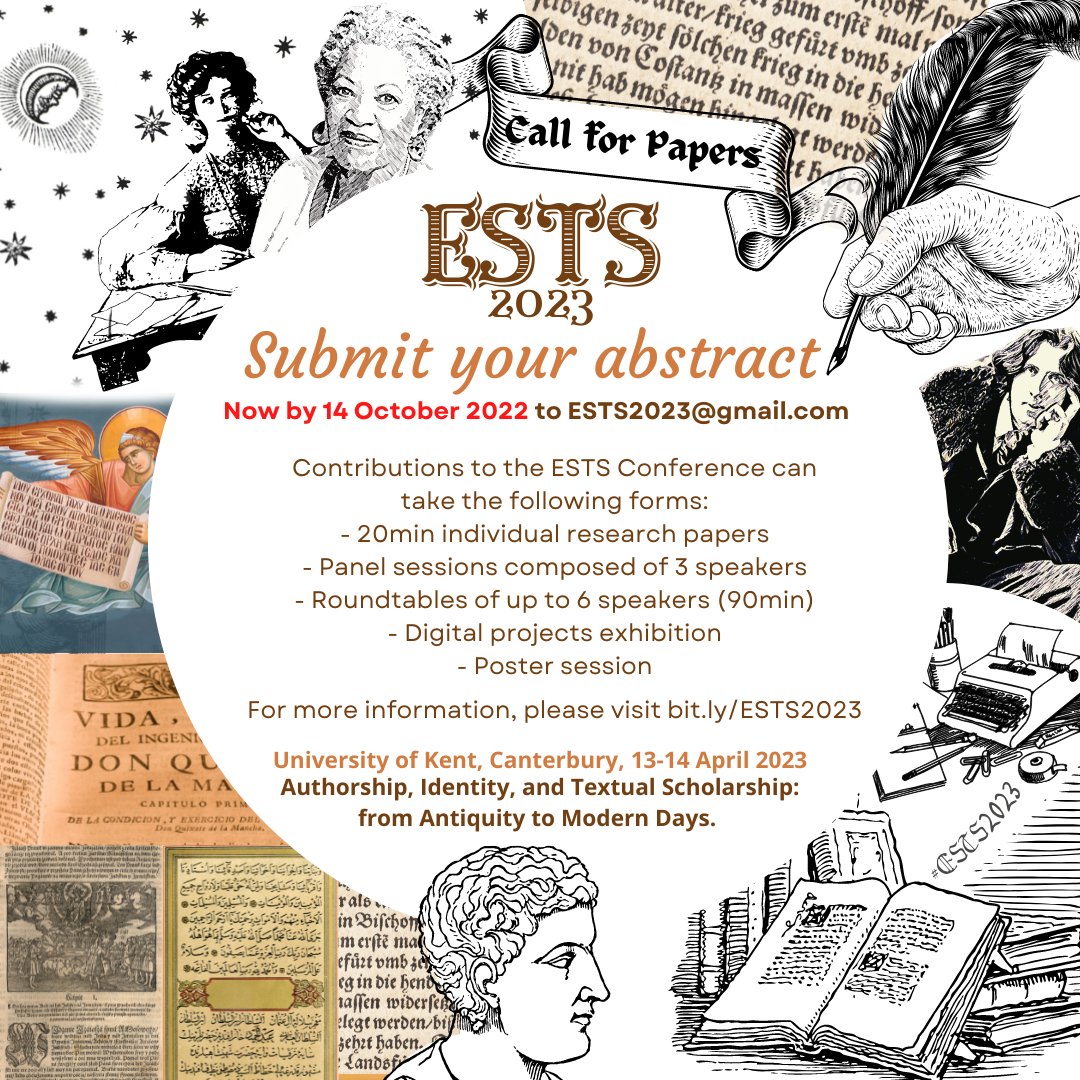
The 18th annual ESTS conference will be taking place at the University of Kent from 13-14 April 2023, and the deadline for proposals has now been extended to Friday 14th October 2022. To read the call for papers, please visit the ESTS 2023 Conference Website, where you’ll also be able to find information on registration, contributions, and where to send abstracts.

Follow the ESTS 2023 Twitter, or join the ESTS Facebook Group for up-to-date announcements and information about the conference.

CFP: DH_Budapest_2019

Via Gábor Palkó

DH_Budapest_2019

Venue: Centre for Digital Humanities at Eötvös Loránd University (ELTE.DH)

Dates: 25-27 September 2019

Call for Papers

Deadline: 31 May 2019

Notification of Acceptance: 15 July 2019

The Centre for Digital Humanities at Eötvös Loránd University (ELTE.DH) calls for abstracts for its second annual conference which will take place in Budapest, 25–27 September 2019 – in collaboration with the COST Action Distant Reading for European Literary Historyproject and the DARIAH Central European Hub. While last year the conference seeked to survey the current state of research in digital humanities in general, this year DH_Budapest_2019 will keep a narrower focus on theories and practices of distant reading.page1image1012014000

The term distant reading (i.e. using computational methods of analysis for large collections of texts) is meant here in a general sense: regardless of genres and disciplines on the side of the used or built corpus, and regardless of computational methods adopted or developed during the research. We encourage speakers to present their work where innovative, sophisticated, data-driven, computational methods play a key role in a scientifically relevant research.

We invite submission of abstracts on subjects from a variety of fields related to digital humanities and social sciences concerning but not limited to following topics:

  • Corpus building using markup languages
  • Automatic and manual corpus annotation
  • Named entity recognition (NER) and named entity linking (NEL)
  • Wikification, wikiDATA linking
  • Stylometry, authorship attribution
  • Vector spaces and neural networks as distant reading tools
  • Network modelling, prosopographical networks
  • Distant reading of historical sources
  • Digital literacy, digital pedagogy

For more information and the conference’s full CFP, please visit the DH_Budapest_2019 website.

CFP: ExLing 2019

via João Dionísio

Abstract submission is now open for the ExLing 2019 workshop (proposals on any experimental aspect of textual scholarship, namely in  connection with digital humanities, are welcome).

ExLing 2019 – 10th Tutorial and Research Workshop on Experimental Linguistics (https://exlingworkshop.com/) takes place at the Faculdade de Letras da Universidade de Lisboa, 25-27 September 2019, under the auspices of Centro de Linguística da Universidade de Lisboa.

As a privileged space for debate among researchers applying experimental and computational methods to the study of language, all experimental disciplines and subjects with reference to the study of language are welcome, including speech production, speech perception, experimental phonetics, experimental morphology, experimental syntax, experimental semantics, cognitive linguistics, neurolinguistics, psycholinguistics, sociolinguistics, computational linguistics, discourse analysis, textual studies, applied linguistics, and language therapy.

Abstracts for oral and poster presentations can be submitted here:
https://exlingworkshop.com/exling-2019/submissions-2019.html

Abstract submission closes on June 1, 2019.
Notification of review results will be sent by June 20.

ExLing 2019 has six confirmed keynote speakers:
Paolo Canettieri – Cognitive philology
Bart Geurts – Evolutionary pragmatics
Jonathan Harrington – Empirical analyses of sound change
Caroline Heycock – Syntactic theory and variation
Jon Sprouse – Experimental syntax</br/>
Marc Swerts – Linguistic adaptation

CFP ESTS 2019

As announced at the Member’s Meeting at ESTS 2018 in Prague, the Society’s 16th annual conference will be held in Málaga, Spain and take place from 28 to 29 November 2019. This year’s theme will be ‘Textual Scholarship in the 21st Century’, and its Call for Proposals has just been put online, with the deadline for submissions set on 31 May 2018. For more information on this CFP, please refer to the conference page.

Please distribute widely. We look forward to receiving your abstracts, and welcoming you in Málaga!

CFP: Writing and Revision Stages

via Elsa Pereira

Dear members of the ESTS, the School of Arts and Humanities of the University of Lisbon is hosting a symposium on “Writing and revision stages”, which will take place on June 6-7, 2019.

We invite researchers to submit abstracts for a 20-minute contribution until the end of 2018. The language of the presentation will be English.

Please send your proposal to philology.clul@gmail.com. Abstracts will be reviewed double-blind by the members of the scientific committee.

Call for papers and full details at the website: https://sites.google.com/campus.ul.pt/writing-revision-stages

Follow us on Facebook:
https://www.facebook.com/writing.revision.stages